Research consistently indicates that students from private and homeschool backgrounds often achieve higher academic and long-term life outcomes compared to their public school counterparts.
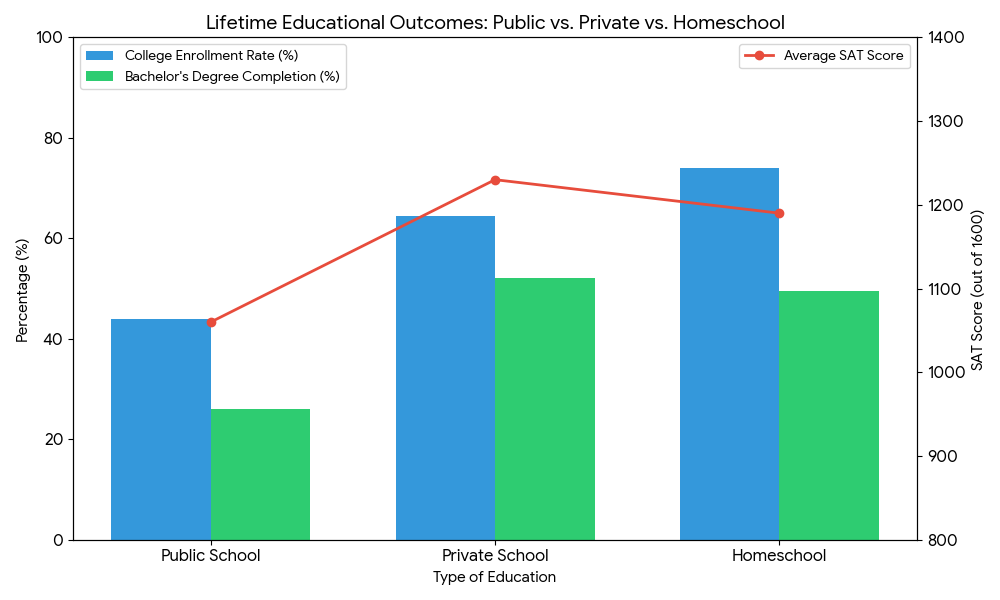
Private Schools: A long-term study by the National Center for Education Statistics (NCES) found that students who attended private school in 8th grade were twice as likely to have completed a bachelor’s degree by their mid-20s compared to public school students (52% vs. 26%).
Homeschooling: Research summaries indicate that approximately 74% of homeschooled students attend college, compared to roughly 44% of public school students. Once in college, homeschooled students often maintain higher GPAs and graduation rates (estimated at 67% graduation vs. 59% for public schoolers).
SAT Scores: Data from 2024–2025 shows private school students average around 1230 and homeschoolers average 1190, both significantly higher than the public school national average of approximately 1060.
Percentile Rankings: The National Home Education Research Institute (NHERI) reports that homeschooled students typically score 15 to 30 percentile points higher than public school students on standardized achievement tests.
Private Schools: A study from the University of Cambridge and the Institute for Fiscal Studies found that private school graduates earn approximately 6% more than their public school peers, even after adjusting for the type of university degree obtained.
Homeschooling: Long-term studies suggest that adults who were homeschooled are more likely to be satisfied in their work and perform at or above the level of their peers in professional settings.
Private Schools: A 2024 meta-analysis published in Educational Research and Evaluation found that private schooling increases civic outcomes (political tolerance, community involvement) by 0.055 standard deviations over public schooling.
Homeschooling: Research from the Cardus Education Survey and Harvard University suggests homeschoolers are significantly more likely to participate in community service and volunteer work (reported up to 33% higher volunteering rates).