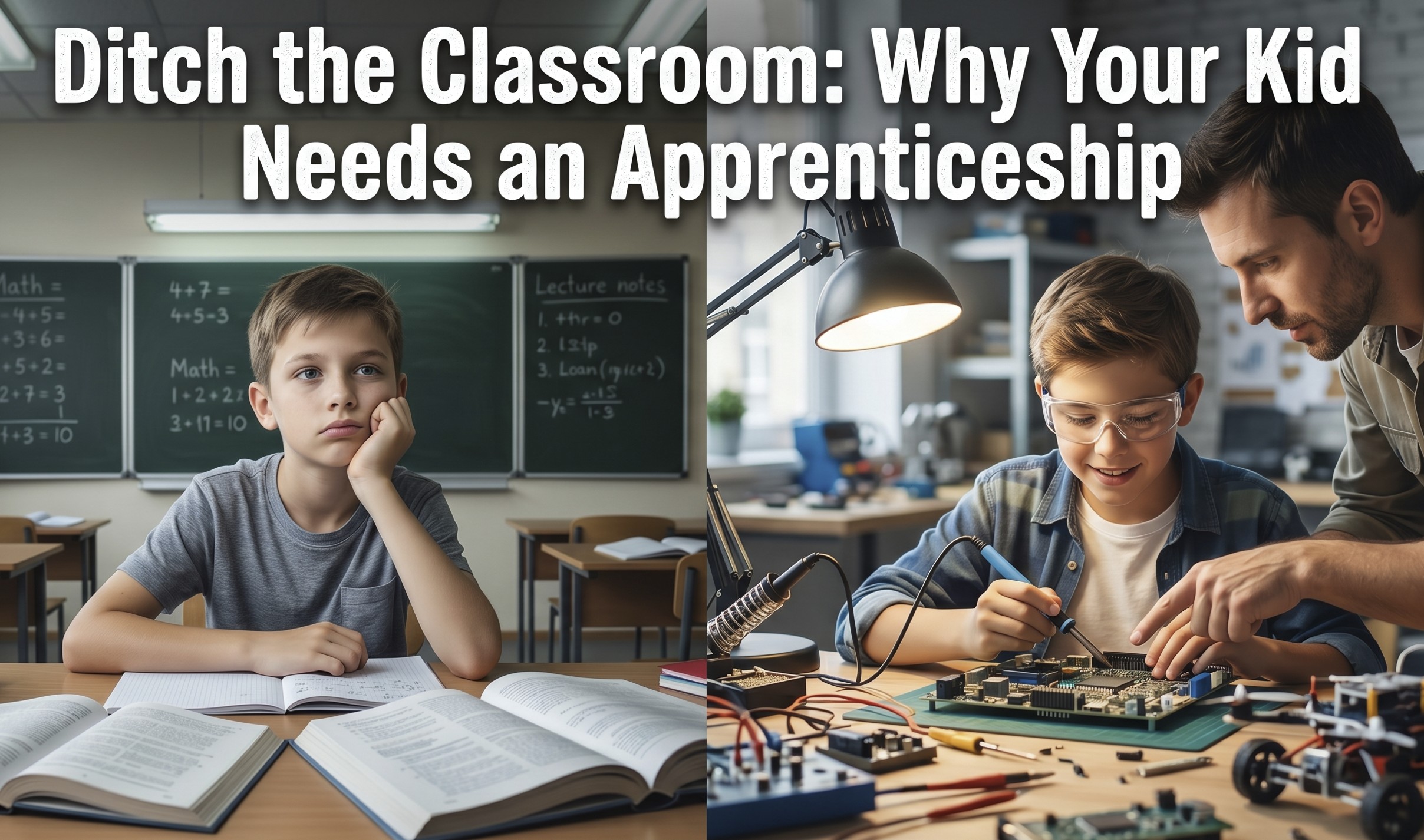
We cage our children in sterile classrooms for seven hours a day and wonder why they are not turning out well (Research links in the first comment). Modern education operates on a broken assumption that kids learn best by listening to lectures and filling out worksheets. Science and history prove the exact opposite. Children crave reality, and they possess a hunger to participate in the adult world. By shifting to homeschooling and localized apprenticeships, we can unlock their true potential and reverse a generational crisis of disengagement.
Consider the data on how human brains actually process information. Research from the National Training Laboratories reveals a stark contrast in how we retain knowledge. Traditional lecture-based instruction yields a dismal five percent retention rate after twenty-four hours. Reading bumps that number to a mere ten percent. But when a child learns by doing, that retention rate skyrockets to seventy-five percent or higher. We are wasting years of a child’s life on instructional methods that fail ninety-five percent of the time, while starving them of the active engagement they naturally crave.
Developmental psychologist Barbara Rogoff pioneered a framework called Learning by Observing and Pitching In, or LOPI. Her research shows that in communities where adults do not segregate children into age-graded schools, young people learn complex tasks rapidly and fluidly. They watch adults work, identify where they can help, and seamlessly step into the action. This matches the historical practice of apprenticeships, which successfully drove human progress for centuries. A child did not sit at a desk to learn blacksmithing, farming, or commerce; they stood beside a master, held the tools, and did the work.
Fusing this real-world apprenticeship model with homeschooling produces staggering results. Free from the rigid assembly line of institutional schooling, homeschooled children thrive. In fact, peer-reviewed studies show that homeschoolers score fifteen to twenty-five percentile points higher than public school students on standardized tests. Furthermore, seventy-eight percent of peer-reviewed academic studies demonstrate that home-educated students outperform their traditionally schooled peers. They do not just memorize facts to pass a test; they master skills because their environment allows them to engage with the world dynamically.
Imagine a childhood where a ten-year-old builds a community garden to learn biology, manages a family business budget to master algebra, and shadows a local graphic designer to understand visual communication. Homeschooling provides the flexibility to replace artificial compliance with genuine competence. When we integrate children into real life alongside invested adults, we do not just teach them subject matter. We give them purpose, confidence, and a massive head start in the real world. Pull your children out of the factory model, embrace the freedom of home education, and let them start pitching in today.