I voted for Trump, but Trump’s Memorandum of Understanding (MOU) with Islamic Republic of Iran reads like a surrender. It is a much worse deal than Obama’s 2015 deal in that it gives far more away in return for far less. I previously shared here my opinion that the only path to victory here would be using ground troops to seize control of the Strait of Hormuz and Iran itself and paying for it by auctioning the $16 trillion in oil fields. I posted a comment below with a summary of the new MOU and breakdown of how it compares to the old deal.
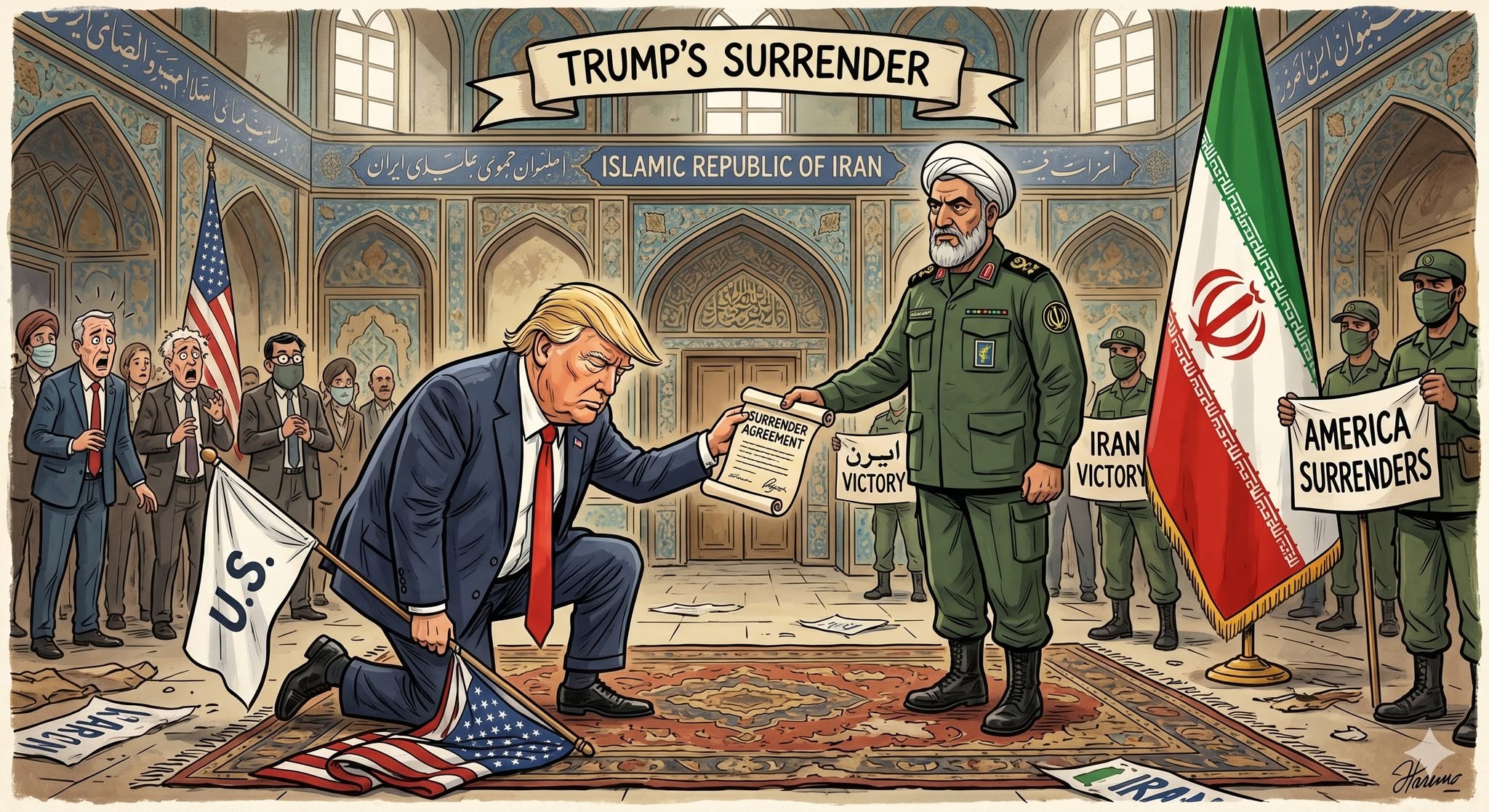
Here is a summary of the 2026 agreement, followed by a comparison with the 2015 Joint Comprehensive Plan of Action (JCPOA) negotiated under the Obama administration.
Summary of the U.S.-Iran U.S. War MoU (June 2026)
Negotiated under the Trump-Vance administration with the mediation of Qatar, Pakistan, and others, this agreement is primarily a ceasefire document designed to end the nearly four-month U.S.-Israeli war with Iran.
Key Provisions:
Immediate Ceasefire & Maritime Security: Halts military operations on all fronts (including Lebanon). The U.S. agrees to lift its naval blockade on Iranian ports, while Iran agrees to clear the Strait of Hormuz of naval mines and return commercial shipping to pre-war volumes within 30 days.
Immediate Economic Relief: The U.S. will immediately waive sanctions on Iranian oil and petrochemical exports and allow the unfreezing of restricted Iranian funds (estimated at $12 billion).
Reconstruction Fund: The U.S. and regional partners agree to establish a $300 billion fund dedicated to the economic development and post-war reconstruction of Iran.
Deferred Nuclear Negotiations: Iran reiterates its pledge never to acquire a nuclear weapon. However, rather than immediately dismantling its nuclear program, the MoU establishes a 60-day window for technical negotiations on the final fate of the program.
Status Quo Period: During these 60 days, both sides maintain the status quo. Iran will not advance its nuclear program further, and the U.S. agrees not to impose new sanctions or build up military forces in the region.
Omissions: The MoU notably lacks any restrictions on Iran’s ballistic missile program or demands regarding the release of political prisoners.
Comparison to the 2015 JCPOA (The “Obama Deal”)
While both agreements aim to mitigate the threat of an Iranian nuclear weapon, their context, structure, and execution are fundamentally different.
1. Context: Post-War Ceasefire vs. Peacetime Diplomacy
2026 MoU: This is first and foremost an emergency mechanism to end a hot regional war and a devastating global maritime crisis. The primary immediate goal is reopening the Strait of Hormuz and stopping military strikes.
2015 JCPOA: The Obama deal was a preventative, non-proliferation agreement negotiated during peacetime by a large international coalition (the P5+1) specifically to avoid a military conflict.
2. Sequencing of Concessions (Front-loaded vs. Compliance-based)
2026 MoU: The Trump administration is front-loading massive economic concessions—lifting the naval blockade, waiving oil sanctions, unfreezing assets, and proposing a $300 billion reconstruction fund—before securing technical concessions on Iran’s nuclear program. The nuclear details are punted to a 60-day negotiation window.
2015 JCPOA: The Obama administration structure required Iran to take major, verifiable steps to dismantle its nuclear infrastructure (removing centrifuges, altering the Arak reactor, and exporting enriched uranium) before the U.S., EU, and UN lifted major economic sanctions.
3. Nuclear Parameters
2026 MoU: Because the MoU maintains a “status quo” for 60 days, Iran is temporarily permitted to keep the highly enriched uranium (reportedly up to 60% purity) it accumulated prior to the war. The ultimate limits (such as a rumored 15-year moratorium on enrichment or down-blending to 3.67%) are deferred to the upcoming talks.
2015 JCPOA: Imposed immediate, stringent caps on the program. Iran was capped at 3.67% enrichment, its stockpile was restricted to 300 kilograms, and it was subjected to the IAEA’s Additional Protocol for unprecedented inspections.
4. Financial Incentives
2026 MoU: The inclusion of a $300 billion reconstruction fund backed by the U.S. and regional partners is a historic economic sweetener designed to rebuild Iran’s war-torn economy.
2015 JCPOA: Did not include U.S. taxpayer or regional funding for Iran. The financial incentive was strictly the unfreezing of Iran’s own overseas assets (roughly $100 billion) and allowing Iran to reintegrate into the global economy.
5. Scope of the Agreements
2026 MoU: Broadly addresses regional military posture, maritime blockades, and proxy fronts (like Lebanon), but explicitly leaves out ballistic missiles.
2015 JCPOA: Strictly ring-fenced the nuclear issue. The Obama administration intentionally separated Iran’s ballistic missile development and regional proxy behavior from the nuclear file to secure the core non-proliferation agreement.