I woke up to a violent banging on my apartment door. I was still half-drunk from the night before, confused, and had no idea that opening that door would change my roommate’s life forever—or that I was about to accidentally hand him over to federal agents.
Here is the full story of the morning ICE arrested my good friend and roommate.
(Note: The first comment will have his perspective on all of this, which he shared with me recently.)
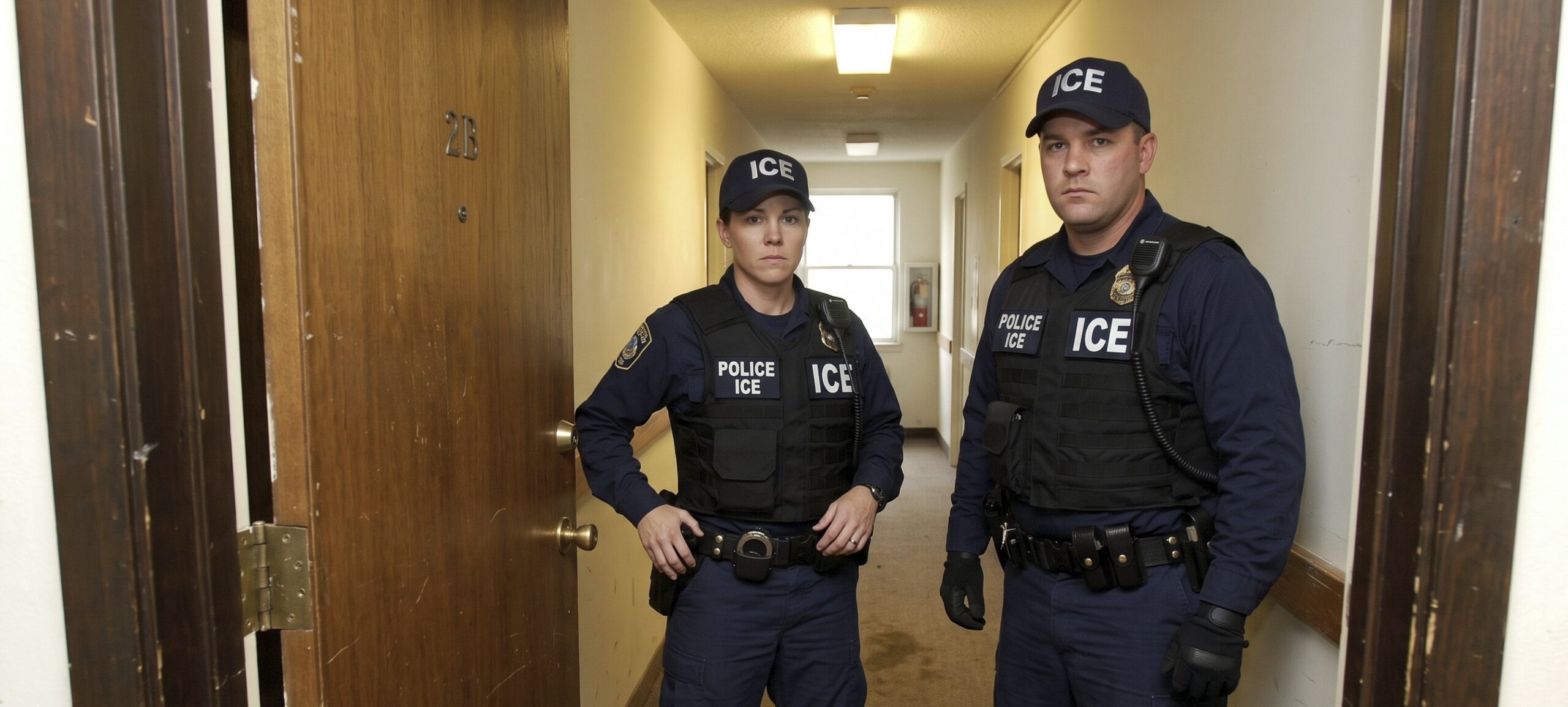
It happened at our apartment just off campus at the University of Washington. I had partied with friends and gotten very drunk the night before. I probably still was pretty drunk, so it took me a while to get out of bed. It was still early in the morning. When I finally dragged myself up, went to the door, and opened it, I saw two uniformed officers standing there. I felt a jolt of shock and wondered what I had done.
They asked me my name and I replied, “Joel.” They asked if Amir (I am anonymizing his name at his request) was home. I said I didn’t know.
At the time, I didn’t even know what an ICE agent was. I thought they were campus police or Seattle police officers. My knowledge of the law back then was poor and mostly theoretical. In my drunken state, I didn’t connect this situation to the business law course I had taken where I learned about our rights. They introduced themselves as “Homeland Security.”
The ICE agents said, “We need to come in.” I said okay and let them in.
They asked to see inside my cupboards. I said, “Ok.” They told me to open the cupboards. Wondering why they didn’t just open them themselves, I thought they believed I must have a bomb in there or something. After showing that my cupboards were empty other than booze and protein powder (college me had the wrong priorities), they asked where Amir was. I said, “I don’t know.”
They asked where his room was, so I took them to his door. They asked me to open it, so I tried the handle, but it was locked. They asked me to knock, so I did. No reply. They then started banging loudly and continued for several minutes. Finally, Amir came to the door—I think he was hungover too.
They asked if they could talk to him, and they all started chatting. I was drunk, so I just went back to bed and passed out.
When I woke up again several hours later, I went about my normal routine. Eventually, I started wondering where Amir was. I then remembered the police officers from that morning and became concerned. I called Amir’s phone several times without success. I started calling his other friends, but no one had seen him. Eventually, I tracked him down to an ICE detention facility in Tacoma.
He hired an attorney and was later deported. He had overstayed his student visa after we graduated. Amir was Iranian, and ICE was probably pretty concerned after 9/11 about Iranians in America illegally.
I still feel guilty about being drunk and letting those ICE agents into our apartment. Knowing what I know now, I could probably have refused them entry. I don’t think they had a warrant, which is why they had me open the cupboards myself and knock on Amir’s door.
What’s funny is that then and now, I support ICE’s actions. It makes sense for America to have immigration laws and control who comes and goes, just like it makes sense that we as individuals decide who comes into our homes and who does not. Beyond that, these are laws that have been in place in our Democratic Republic for centuries now, and all of our laws should be enforced. If people don’t like the laws, they need to have Congress change them.
But then and now, I put my family and friends ahead of such things. Back then, I actually thought about if it would be possible to break him out of the detention facility. Probably not very smart of me. I was an idiot to start with for allowing them into our apartment.
I remember when Charlie Kirk was murdered, the father of one of the killers was the one who turned his son in. I could not see myself doing that—I would do my best to hide my son. But I would kick his ass from here to the moon for having done such a stupid and evil thing. I see the obvious necessity for laws against murder and the vigorous enforcement of such laws.
But immigration poses a massive structural threat. Basic economic theory clearly shows that people will take the better option. If someone lives under a dictator in, say, North Korea and is starving, they will move here. If we allowed all illegal immigrants who want to come to come, they will keep coming until the United States has a quality of living equivalent to the lowest quality of living of any country in the world. People will always come if they can have a better life.
We would see billions more people living in the United States, most of whom have never heard of our Constitution or Bill of Rights and do not agree with any such concepts. The infrastructure of America currently barely maintains the people that already live here. Programs like Social Security and Medicare and public schools and all the rest of the government programs would collapse. The electrical grid would only be able to support a fraction of the population, so most of us would live without power, running water, or toilets. Most of us would end up being priced out of even the basic necessities like power, water, and maybe even food. It would be a complete and total disaster.
Enforcing immigration laws, as you can see, is absolutely as essential as enforcing laws against murder. I can definitely empathize with the anti-ICE protesters who want to help the illegal immigrants who are forced to leave. But as a nation, we have to defend our borders so that we and our children can maintain our standard of living, as well as the freedoms and rights that most other people in the world do not understand or agree with.
This is an issue I struggle with. I guess for me, the law is very important and I deeply understand the need for laws to protect us all—but I still see my family and friends as even more important.
Image: I created this image to best match what I saw that morning two decades ago.
Amir’s perspective copied and pasted here: Regarding my ICE arrest, I completely understand why it happened, and I don’t blame the officers involved. I was technically out of status. Although I had applied for an extension of my visa before it expired, my application was ultimately denied. Once that happened, I knew I was no longer legally in the country, so I can’t really complain about the fact that I was arrested. They were simply enforcing the law.
What actually surprised me was how professional and respectful the officers were throughout the entire process. They treated me with dignity from start to finish. One of the female officers even gave me her personal cell phone number and told me to pass it on to my family so they could contact her directly. She wanted them to know where I was being held and to explain what steps they needed to take to arrange my release. That level of kindness wasn’t something I expected.
Even while I was handcuffed in the back of the police car, the male officer apologized to me for having to arrest me. He told me that I wasn’t the kind of person they were really looking for—a university student with no criminal record who had been trying to do everything the right way. He explained that, in his view, the immigration environment had changed dramatically after 9/11, and that people from Middle Eastern countries often faced much greater scrutiny as a result.
My real disappointment isn’t with the officers who arrested me; it’s with the immigration system itself. I came to the United States to build a better future. I paid my own way through university without relying on government assistance, worked hard, stayed out of trouble, and wanted nothing more than the opportunity to contribute to society and build a life there. Instead, I found myself being forced to leave because of my immigration status.
What makes it even harder to accept is that there are tens of thousands of people every year whose stories are similar to mine—people who came legally, studied, worked hard, and genuinely wanted to contribute, but ultimately had to leave because they couldn’t find a path to remain. That was the part that I found most discouraging.
Personally, I believe the U.S. immigration system is in need of significant reform. In its current form, it often loses talented, ambitious people who have the skills, education, and motivation to make meaningful contributions to the American economy and society.
One of the biggest contradictions, in my opinion, is how the system treats international students. The United States actively encourages students from around the world to attend its universities, many of which are among the best in the world. These students invest enormous amounts of money in tuition, support themselves while studying, earn American degrees, and become highly skilled professionals. Yet, after graduation, many discover that there is no realistic pathway for them to remain in the country and enter the workforce, despite wanting to build their careers in the U.S.
As a result, tens of thousands of well-educated graduates are forced to return to their home countries or relocate elsewhere. They take with them the education, knowledge, and experience they gained in the United States and use those skills to strengthen other economies instead. From both an economic and strategic perspective, that seems counterproductive. After investing in educating these individuals, the U.S. often misses the opportunity to benefit from the very talent it helped develop.
Of course, every country has the right to control its borders and decide its own immigration policies. But I believe there is a strong case for creating a more practical and merit-based system—one that makes it easier for highly educated, law-abiding graduates who want to work, pay taxes, and contribute to American society to remain in the country after completing their studies.
How can someone simultaneously be “law-abiding” while admitting to breaking laws? Make it make sense. Also, your AI image has the officers opening the door to you. Maybe a little more scrutiny and less emotion is deserved next time.