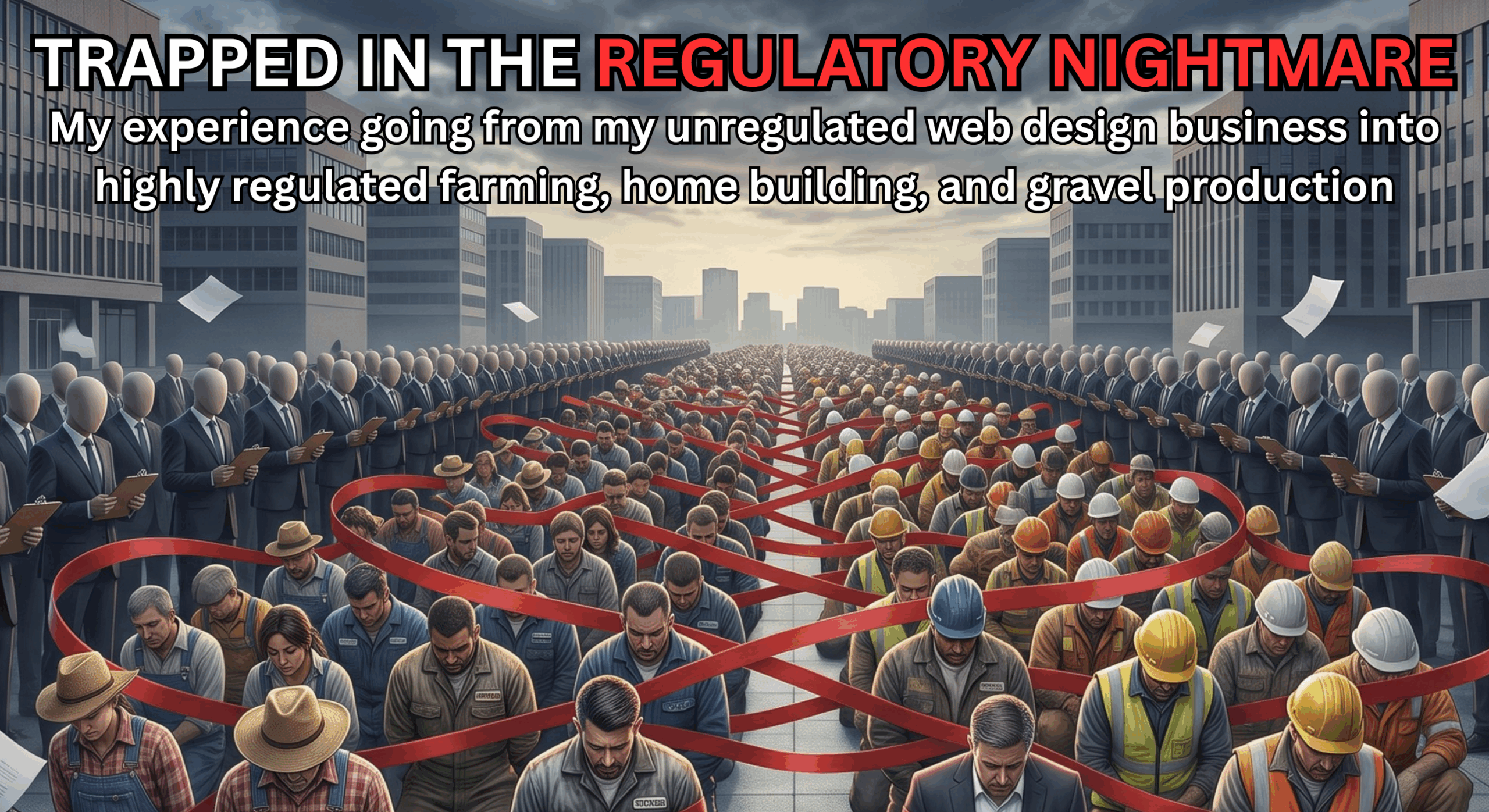
I built a successful web design business with virtually no government oversight—so nothing could have prepared me for the shock of stepping into three of America’s most heavily regulated industries.
Sure, my web agency had standard taxes and basic labor laws, but we didn’t have specialized government regulators breathing down our necks. Back then, I thought standard rules were onerous. I had no idea how lucky I was. My success was simple and direct: provide great work fast, at a fair rate.
Then I stepped into farming, home building, and gravel production. Here is what I discovered:
A major portion of farm revenue is directly controlled by government programs that pay farmers not to produce on certain land, to underproduce specific crops on other land, or to execute mandated conservation tasks.
Think about that: your revenue isn’t based on your ability to grow great food people actually want to eat, but on the whims of bureaucrats. It doesn’t matter what my customers think—it matters what a stranger in an office, who will never touch what I produce, thinks.
In major western Washington State counties, studies show that a full one-third of the total cost of a new home is driven entirely by direct government regulations—not land, concrete, framing, or electrical work.
And that doesn’t even account for the tax dollars funding the regulators’ salaries, facilities, or internal administrative bloat (accounting, IT, DEI hierarchies, HR). Worse yet, it ignores the devastating cost of red-tape delays. In Pierce County, we have been waiting five years just to get approval to split a 20-acre parcel into two 10-acre lots so a family can finally build a home!
I’ve been investing in gravel production equipment, and even before officially starting operations, this field has proven to be the scariest of them all. Regulators at the state, county, and federal levels all want their hands on you.
Other owner-operators in the industry warned me that the Mine Safety and Health Administration (MSHA) wields near-absolute power. They can fine you based purely on hypothetical outcomes. One operator was cited because he parked his excavator with the bucket on the ground but the thumb raised—the inspector told him he could be fined for a potential fatality simply because of what might have happened.
The biggest problem with all of these regulations is that they decouple the economic producer from doing their best to create goods that consumers actually want. The mentality shifts from maximizing efficient production to jumping through hoops.
To survive, your mindset has to change: you end up playing arbitrary games just to appease whichever random bureaucrat happens to hold authority over you.